Demo App: From Idea to Published Terraform Provider
A month ago I started learning Go by building a demo app. Today I have a published Terraform provider on registry.terraform.io. Here’s what I built and what I learned.
What is Demo App?
As a Solutions Engineer, I constantly need something to deploy when demoing infrastructure tools. The app itself isn’t the point — it’s a vehicle to show that Terraform provisioned something, Vault injected secrets, or traffic is flowing through a network appliance.
Most options are either too simple (nginx default page) or too complex (real apps with dependencies). Demo App sits in the sweet spot:
- Single binary with embedded frontend
- REST API for CRUD operations
- Display panel that accepts arbitrary JSON
- System info panel showing hostname, IPs, environment
- Prometheus metrics endpoint
- Structured JSON logging
Try It Yourself
The whole point is that this works with one command. If you have Terraform and Docker installed:
git clone https://github.com/billgrant/demo-app-examples.git
cd demo-app-examples/baseline
terraform init
terraform apply
Open http://localhost:8080 and you’ll see:
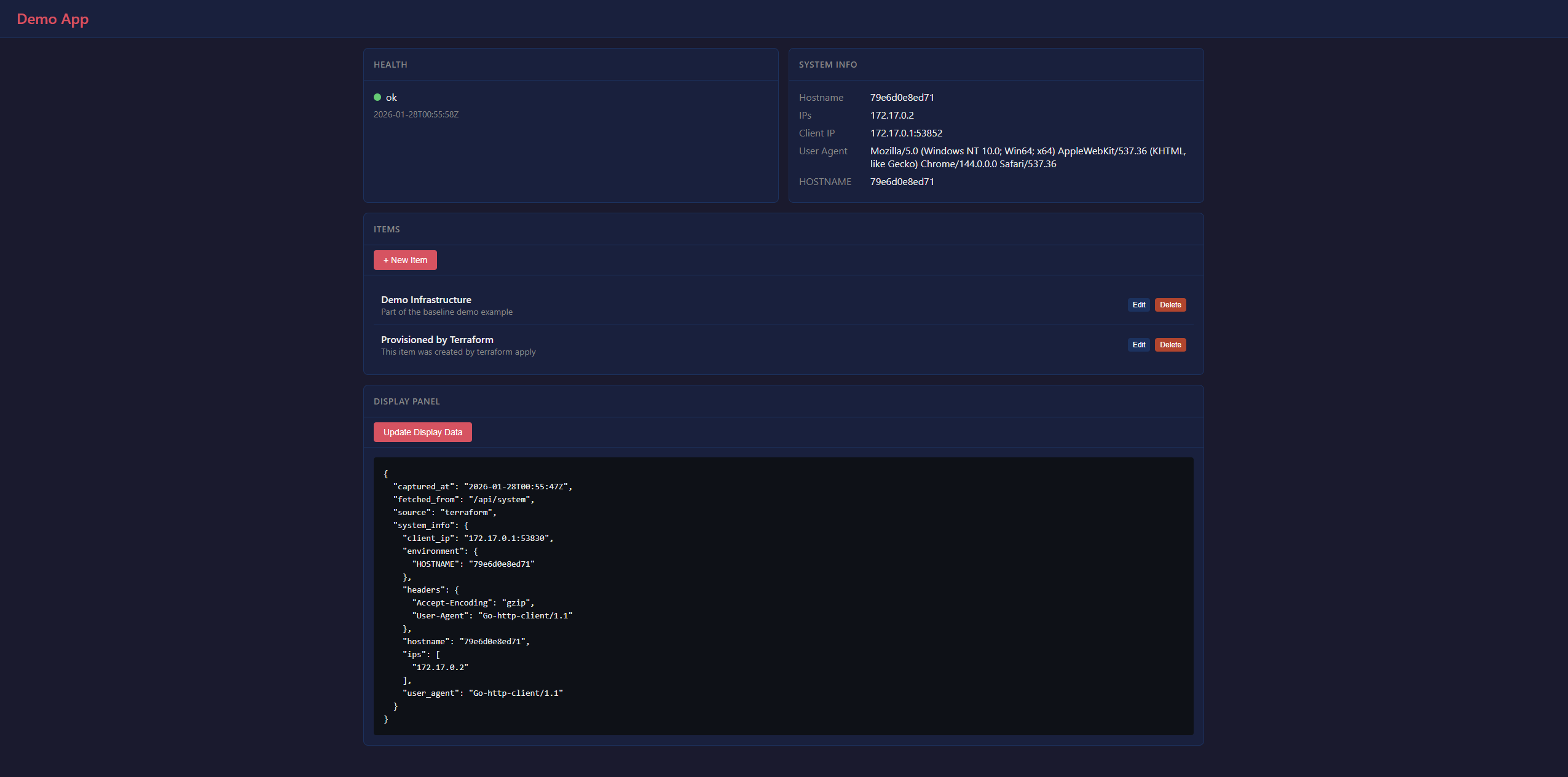
That’s it. Terraform spins up the container, waits for it to be healthy, then uses the DemoApp provider to populate data. If the app crashes, terraform apply restores everything from state.
The Three Repos
| Repo | Purpose |
|---|---|
| demo-app | The application itself |
| terraform-provider-demoapp | Terraform provider for managing app resources |
| demo-app-examples | Ready-to-run Terraform configurations |
What I Learned About Providers
I’ve been using Terraform for almost 10 years and selling it for four. I always wanted to understand how providers actually work at the code level. Building one taught me:
Providers are simpler than they look. It’s HTTP calls wrapped in a framework interface. The plugin framework handles all the gRPC plumbing — you just implement CRUD methods.
The mental model that clicked: Providers are like printer drivers. Terraform Core doesn’t know how to talk to your specific API. The provider speaks both the Terraform interface and your API’s protocol.
What maintainers deal with: Schema design, state drift handling, error messages, documentation for the registry. I have more appreciation for the providers I use daily.
The Stack
Built entirely with Claude as my coding partner:
- Go — stdlib
net/http,log/slog,embed - BadgerDB — embedded K/V store (replaced SQLite for concurrent writes)
- Docker Hardened Images — security-first containers
- GitHub Actions — CI/CD for both repos
- GoReleaser — GPG-signed provider releases
What’s Next
The baseline demo works. Next up is expanding the example library:
- Vault integration (inject secrets into display panel)
- Observability stack (ship logs to Grafana/Loki)
- Multi-tier demo (two app instances talking to each other)
- MCP server (AI agent managing app state)
This project is documented in the DEVLOG if you want the session-by-session breakdown of what I learned.
P.S. Claude helped me write this post.